Thanksgiving to the Lord of the universe, who made heaven and earth, the sea, and everything in them.
(Psalm 146:6)
Newsletter no 2 — August 2026
Santa Teresa, Espírito Santo, Brazil — Atlantic Forest
August was the busiest month since the project began: more than eleven hundred new observations entered the archive.
The species count grew more slowly than the observation count — thirty-one new ones — and that is both expected and healthy. As an inventory matures, each new species costs more effort. Most of those added in August are organisms that were always there and have only now been seen.
The archive has received 9,334 identifications. Even so, most observations remain in the “Needs ID” category, waiting for someone to recognise what is in the picture. That is why identifiers get a whole section in this newsletter rather than a footnote: without them, 5,290 photographs would be nothing more than an album. Anyone who identifies has plenty to do here.
One more note on what the archive is made of: plants and insects dominate the species diversity recorded, while birds — the visual mainstay of our channel — take up a far more modest share. What gets filmed and what gets documented are not the same thing.
In August the project gained its eleventh observer: José Alfredo Ferrari, Professor Ferrari, who runs Sítio Canaã and has known every trail on this land for decades. A single observation — and yet nothing else this month means as much.
The archive now holds records from three generations of the same family, in the same place. Professor Ferrari, who cared for the forest. André, who documents it. And Valentina, with one hundred and sixty-four observations and seventy-seven species — among them, as you will read below, the only record in the municipality for a species the world has seen thirty-two times.
It is a simple and ancient thing: to look at what was created and acknowledge whose work it is. The tools have changed — today there are cameras, apps and databases — but the gesture is the same one the Psalm describes. The forest belongs to none of us. We are only the ones who happen to be looking, for now.
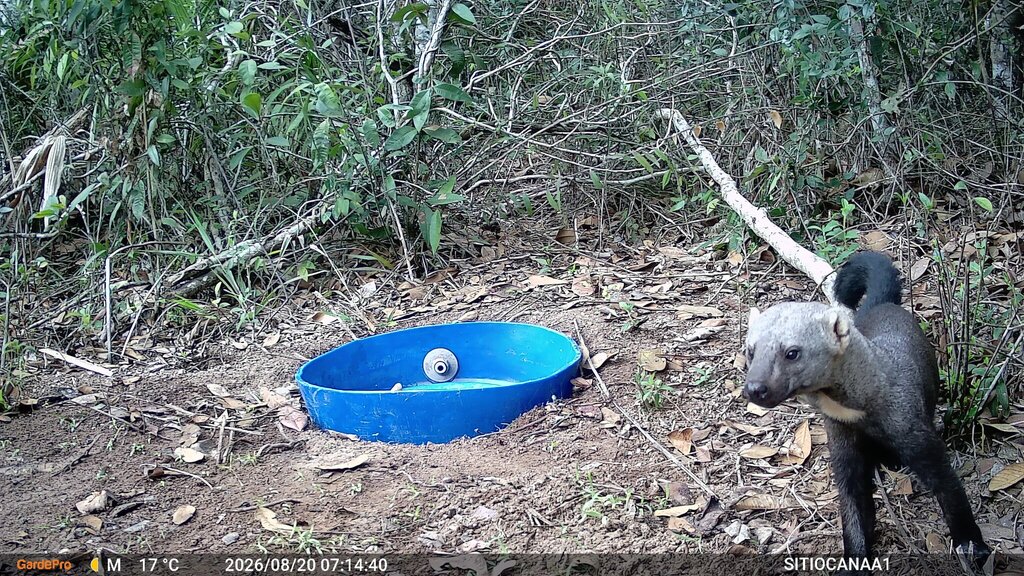
The tayra is one of the hardest carnivores to see in the Atlantic Forest. A relative of otters and weasels, it climbs trees easily and has a strong liking for honey and fruit — which earned it the name papa-mel, honey-eater, across much of Brazil. It is active by day, yet discreet enough that a person can spend a lifetime walking these forests without ever noticing one. Recording it is almost always the work of a patient camera.
The International Union for Conservation of Nature lists the species as Least Concern, and that is precisely where the misunderstanding lies. The category does not mean the species is doing well: it means only that there are still enough individuals not to trigger the alarm. The population trend is one of slow, continuous decline.
The threats are the usual ones, and all of them human — roadkill, contact with domestic animals bringing competition and disease, sugarcane burning, and conflict with people who keep poultry or bees and see the tayra as an enemy. The subspecies E. b. senex is already listed as Vulnerable, and in the state of Rio Grande do Sul the species as a whole appears as Vulnerable on the state list, while remaining Least Concern in São Paulo and Paraná.
That is why records like this one matter. A tayra photographed in a remnant of more than thirty hectares of Atlantic Forest is not just a pretty image: it is a data point, with a date and a coordinate, available to anyone studying the species’ distribution. Species that are not yet threatened are exactly the ones that benefit most from being tracked before they are.
Sources: IUCN Red List and Brazilian state lists of threatened species.
View observation on iNaturalist →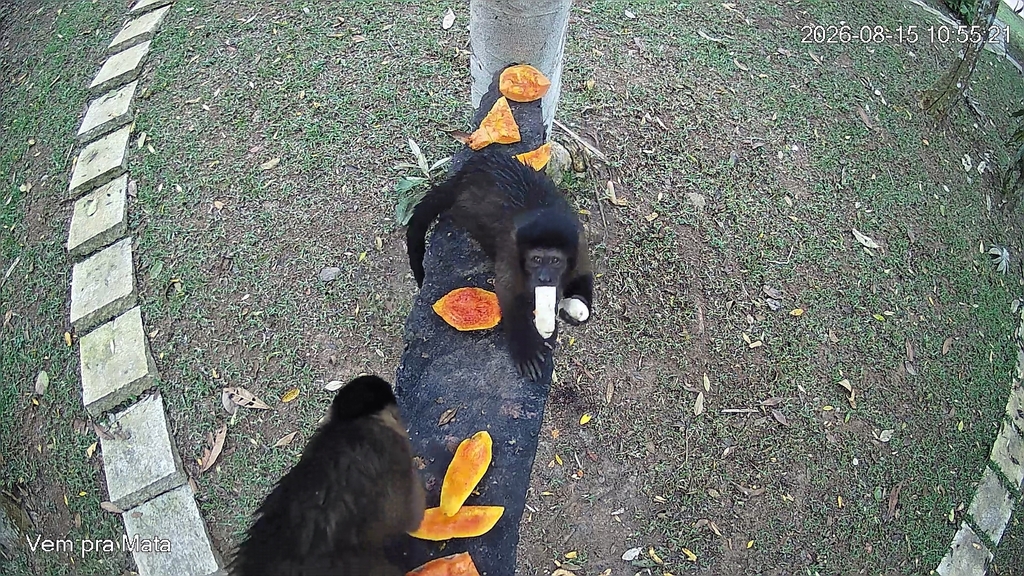
Endemic to the Atlantic Forest and listed as Near Threatened, the black capuchin is one of the most frequent species in the archive, with ninety-four accumulated observations. Here the news is not a rare encounter but the opposite: a primate of continuous forest that remains, year after year, in a remnant of more than thirty hectares of native vegetation.
The August record shows two individuals feeding on fruit at the feeder in mid-morning light. In conservation, steady presence is as eloquent an indicator as a new species.
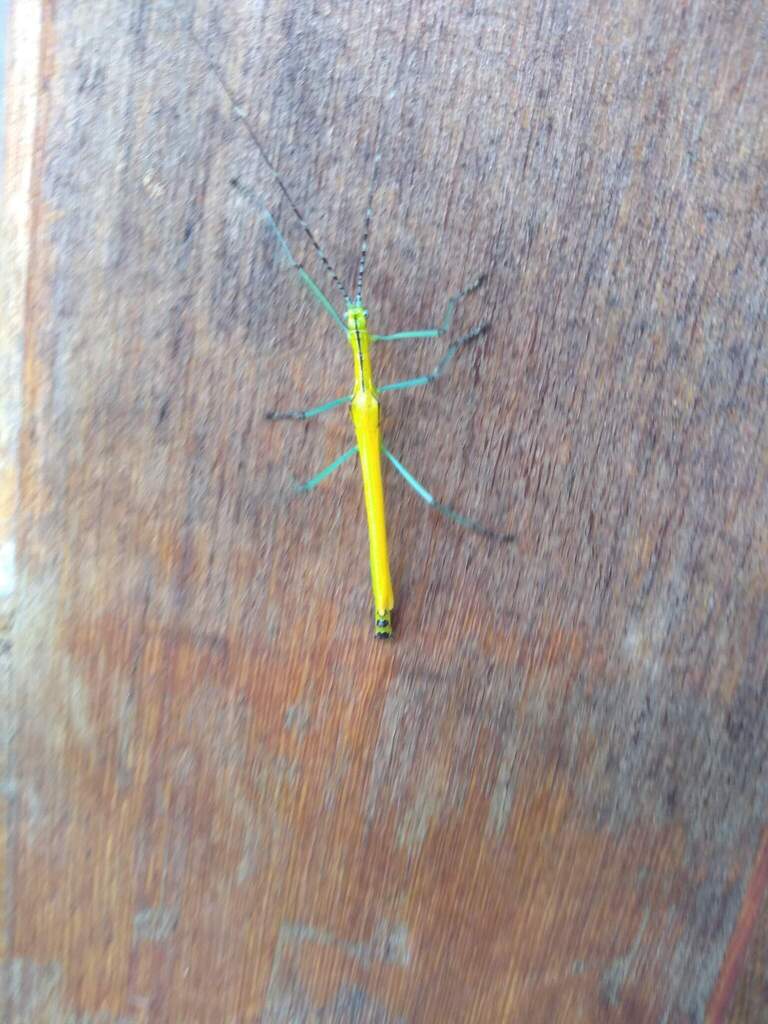
View observation on iNaturalist →Some insects are shaped in such a way that the shape itself is a disguise, and stick insects are the extreme case: an elongated body, stillness through the day, an appearance indistinguishable from a dry twig. The consequence is that almost nobody records them — not because they are rare, but because they are invisible. In the iNaturalist counts, the two species below are among the least documented in the world.
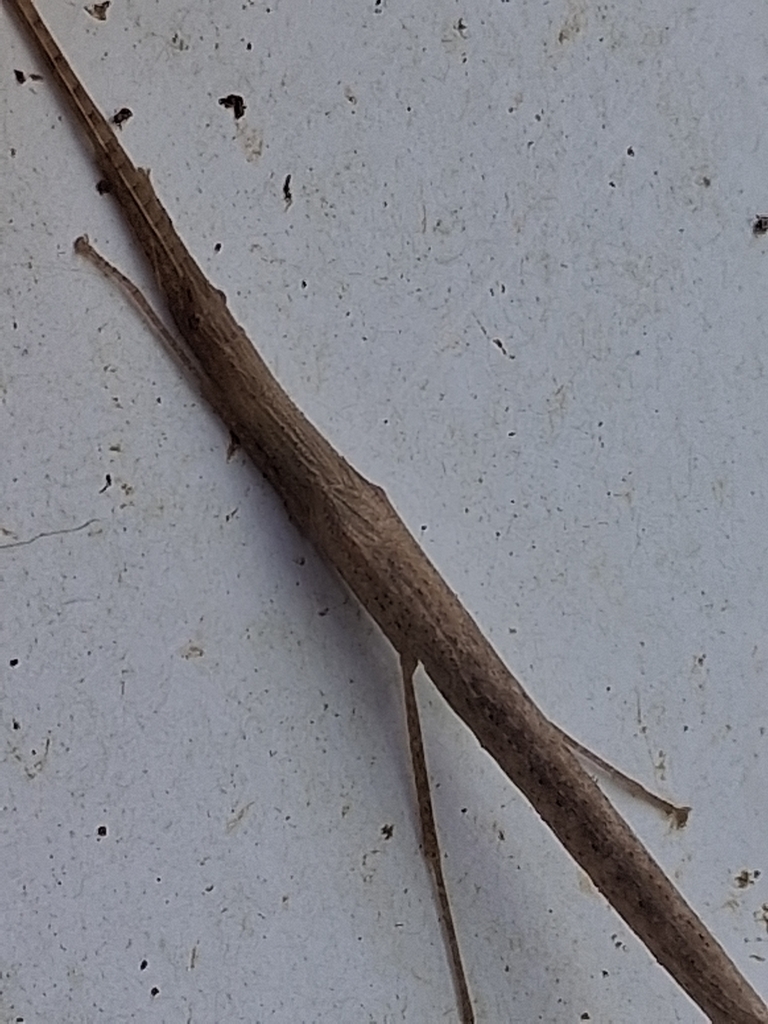
Metriophasma pericles has thirty-two observations on the entire planet, all of them in Brazil. Two in Espírito Santo. One in Santa Teresa — and it is ours, made by Valentina Ferrari. The only record in the municipality for a species the world has seen thirty-two times. View observation →
Tithonophasma tithonus has one hundred and sixty-seven observations worldwide, one hundred and sixty-six of them in Brazil. View observation →
Neither is rare in the biological sense — no study claims that. What the numbers say is something else: these are species almost nobody looks for, and which only enter common knowledge when someone points a camera at the right branch. That is why the rarity ranking on our site carries a permanent notice: it reflects the records that exist on the platform, not the species’ actual biological rarity.
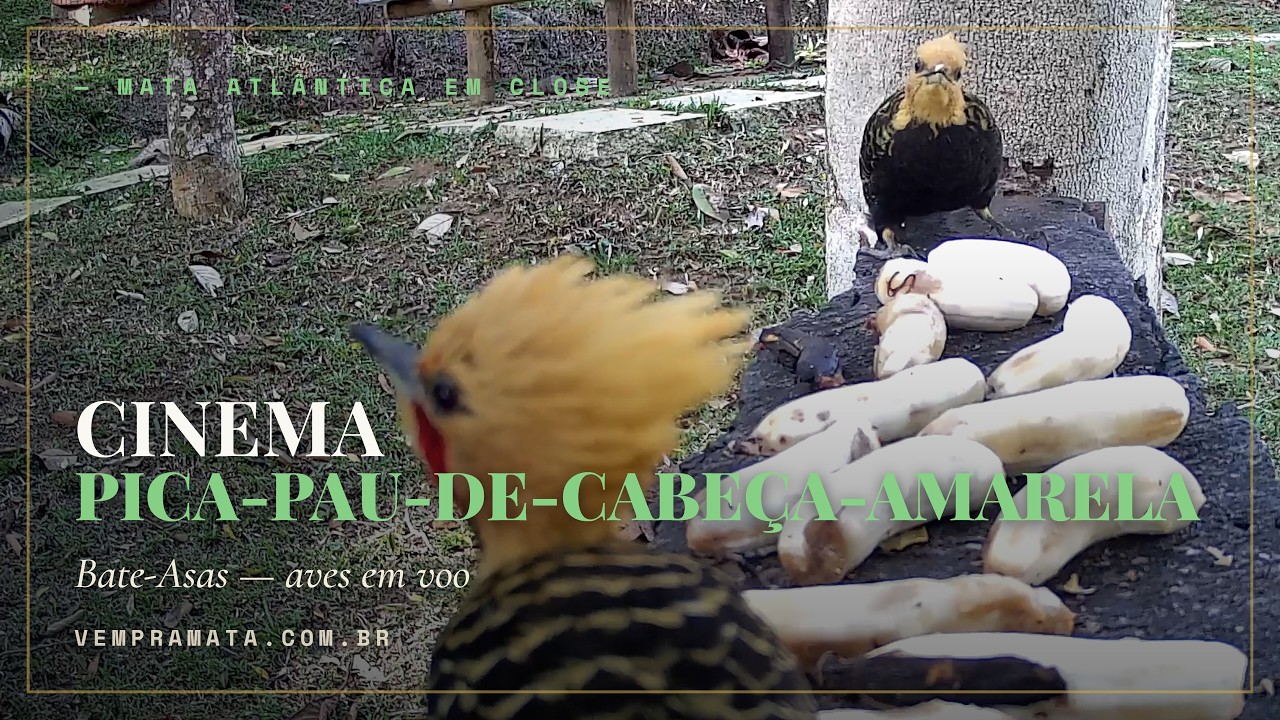 ▶ Watch on YouTube
With ninety-two observations in the archive, the blond-crested woodpecker is among the most recorded birds at the site. The pale yellow crest and the dark, speckled body make the species unmistakable even at a distance.
View observation on iNaturalist →August was also the month in which the project stopped merely producing data and began producing tools for the people who work with that data. Four apps were built in sixteen days, all free, open to anyone, and based on the public iNaturalist API.
Shows graphically who identifies what. Given a species, a taxonomic group or a user, the app draws the network linking those who observed to those who identified. It is a way of making visible a kind of work that usually goes unnoticed.
Open the app →Answers a practical question for anyone heading into the field: when does it appear? It gathers a species’ observations by hour of the day and month of the year, with distribution maps.
Open the app →Lists each participant’s candidate observations for the iNaturalist Brazil Photo Contest 2026, separated by category, already checking licence and identification grade. It saves the manual work of digging through one’s own archive.
Open the app →Annual series of iNaturalist metrics for Brazil as a whole: observations, species, observers and identifiers, year by year. It was with this app that we identified, in August, the 1,956 species awaiting identification in the country that could be resolved by specialists.
Open the app →The apps go to sleep when not in use. The first visit may take a few dozen seconds to load — that is not a failure, just the instance waking up.
The feeder camera remains installed and working, and July’s test proved that live streaming is possible. What we have not solved is making it continuous: the current setup requires a computer left permanently switched on, which is not sustainable.
We are still looking for a way to stream autonomously. If anyone has faced this with Intelbras IP cameras, please write to us — the experience of someone who has already been through it is worth more than any manual.
The contest closes on 31 August. Each participant may submit up to three observations per category — vertebrates, arthropods and other organisms — requiring Research Grade and a CC0, CC-BY or CC-BY-SA licence.
Our thanks to Enrico Tosto and the Brazilian Naturalists Network for organising the contest and for their continuous work bringing the Brazilian iNaturalist community together.
- 🌐 Website: vempramata.com.br
- 🦋 iNaturalist project: Vem Pra Mata
- 📺 YouTube: @vempramata
Identification is what turns a photograph into scientific data.
- 🥇 @enricotosto96 1,353 identifications
- 🥈 @guilandrade 601 identifications
- 🥉 @vitorcdg 232 identifications
Special mention to @guilandrade, who added 440 identifications in August alone and moved into second place. Our thanks also to @lsueza (149) e @medina112 (124), who complete the top five.
O Vem Pra Mata is a Nature Cinema Studio dedicated to recording the fauna and flora of the Atlantic Forest in Santa Teresa, Espírito Santo, Brazil. We bring together cinema, citizen science and contemplation of creation.