God, who made the heavens and the earth, the sea and all that is in them.
(Psalm 146:6)
Newsletter no 3 — September 2026
Santa Teresa, Espírito Santo, Brazil — Atlantic Forest
September was our busiest month yet. The collection grew at a pace no previous month had matched, and the number of observers reached eleven — people from outside the family have begun recording the life here.
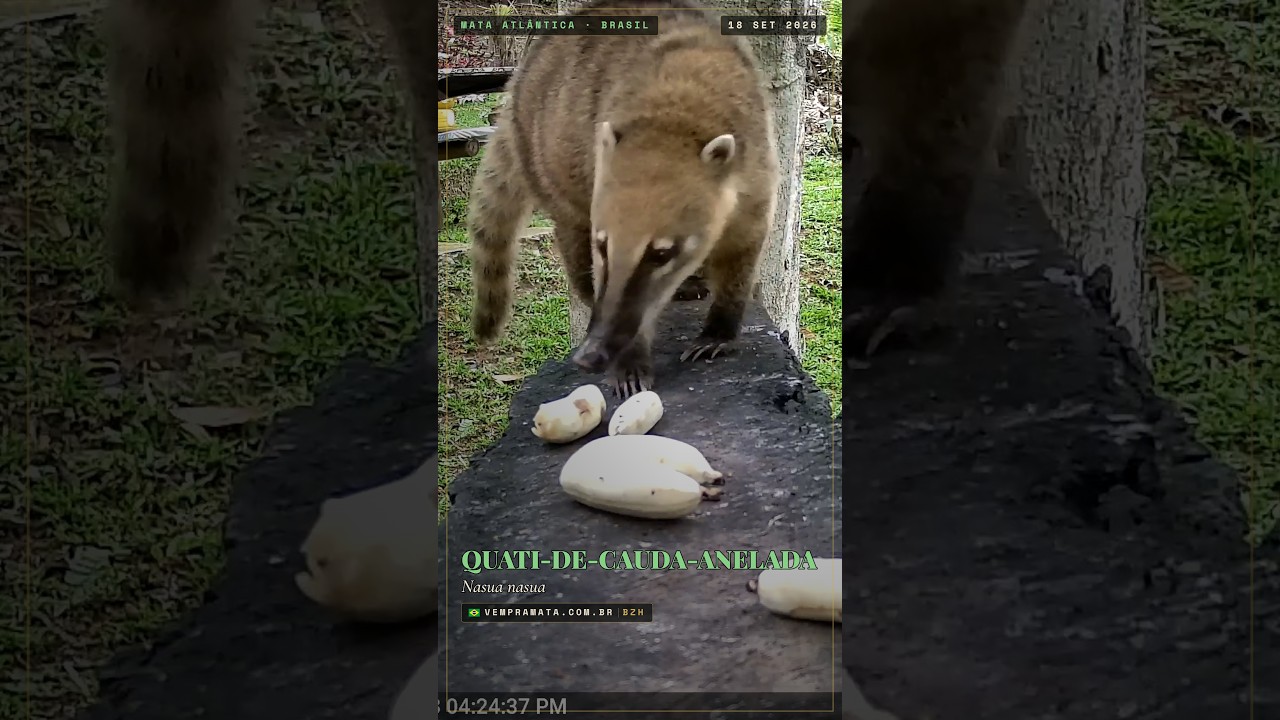
A pair of coatis turned up at the feeding station between 18 and 20 September, and stayed long enough to be filmed at leisure. The video below shows one of them alone, turning over whatever it finds.
 ▶ Watch on YouTube
See observation on iNaturalist →
The month brought two species never before recorded at the site.
The Ariel toucan, a bird listed among the species of conservation concern by the International Union for Conservation of Nature, was photographed on 3 September. See observation →
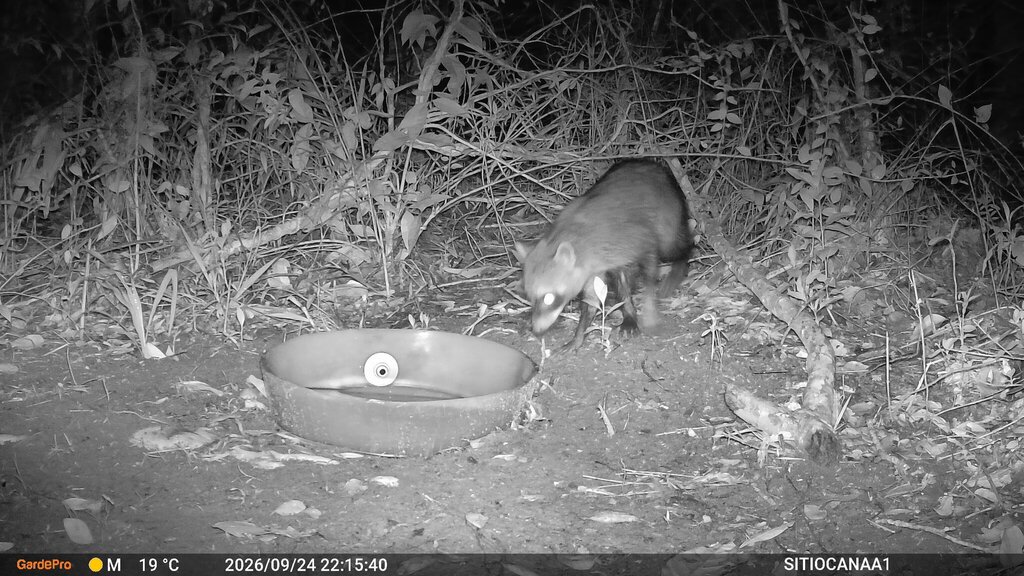
The crab-eating raccoon (Procyon cancrivorus) was caught by the night camera. A nocturnal, water-loving procyonid — a relative of the North American raccoon — it goes unnoticed even where it is common. See observation →
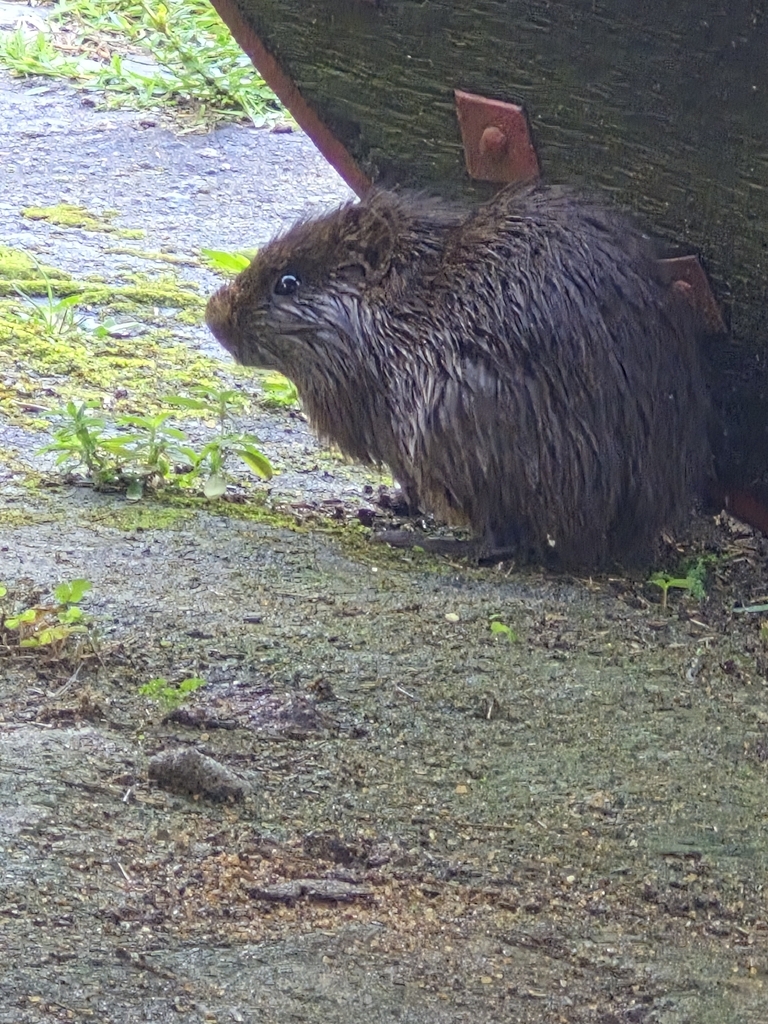
We were all at the edge of the lake when we noticed something struggling in the water. It was swimming without direction, reaching no shore. From a distance there was no telling what it was: a forest rat, a young capybara, nothing we could name. Alfredo, from the bank, reached the little animal and set it on dry ground, from where it made for the safety of the forest.
Only later, with the photograph on the screen, did the name come: shiny guinea pig, an Atlantic Forest rodent related to the domestic guinea pig. And with the name came the surprise. On iNaturalist the species has just 84 records worldwide, 82 of them in Brazil and twenty in Espírito Santo. Ours is the second from Santa Teresa.
Eighty-four records. An animal that exists, that swims and dives to escape predators, and that crosses the forest right beside us — and of which the entire world holds fewer than a hundred photographs.
See observation on iNaturalist →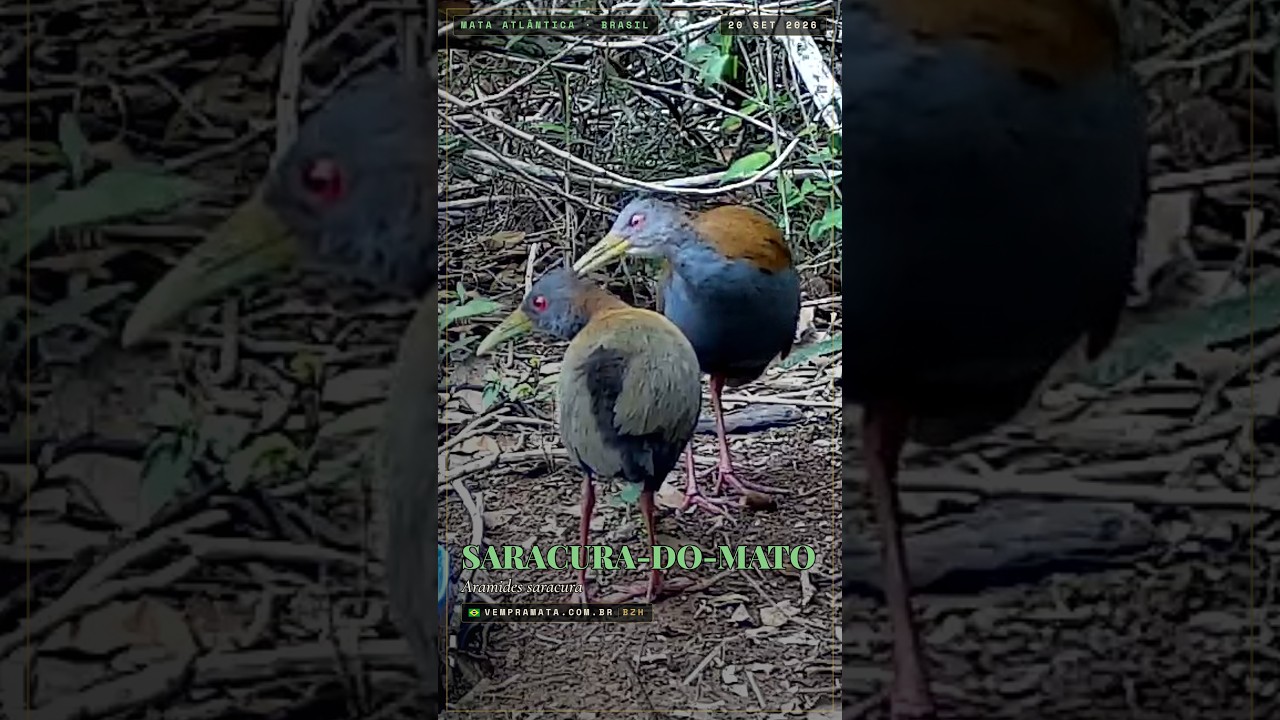 ▶ Watch on YouTube
Two slaty-breasted wood-rails, one preening the other. There is not much to explain about a video like this; better to watch it.
This month the project's most fruitful encounter happened far from the trails — on the iNaturalist forum.
An observer complained that there was no way to know how many records of a species exist worldwide, nor what share of them is one's own. That is precisely what our iNaturalist Ranking does — and that is what we answered, with the numbers from this site: for some Atlantic Forest species, such as the slaty-breasted wood-rail, the records made here are among the most numerous on the planet.
The conversation brought corrections and suggestions from observers in several countries, which have already become improvements to the app. A small tool, built in the interior of Espírito Santo, being refined by people who have never heard of Santa Teresa.
Coming in October. 9–11 October — Renan Betzel (Instagram) and Athos Souza (WikiAves) return to the site, this time for eBird's October Big Day, the largest global birdwatching event. They arrive on Friday and stay through Sunday, with Saturday given over entirely to the trails. Whatever is recorded will appear in the October newsletter.
In September, Vem pra Mata was the subject of a report in the Espírito Santo press. The article presented the project for what it is — a stretch of Atlantic Forest in Santa Teresa where cameras, a mobile phone and a recorder document what passes through — and carried on its front page a camera-trap image taken here: a coati at the feeding station.
All the apps are free, open to anyone and built on the public iNaturalist API.
Generates collectible cards of recorded species, in the style of sticker albums, from any iNaturalist observation.
Open app →Shows your worldwide standing for each species you have observed or identified, with the share your records represent of the global total.
Open app →Answers a practical field question: when does it appear? Groups a species' observations by hour of the day and month of the year, with distribution maps.
Open app →Shows graphically who identifies what. Given a species, a taxonomic group or a user, the app draws the network linking observers to identifiers.
Open app →Annual series of iNaturalist metrics for the whole of Brazil: observations, species, observers and identifiers, year by year.
Open app →The apps go to sleep when not in use. The first access may take a few dozen seconds to load — that is not a fault, just the instance waking up.
- 🌐 Website: vempramata.com.br
- 🦋 iNaturalist project: Vem Pra Mata
- 📺 YouTube: @vempramata
A photograph only becomes scientific data when someone identifies it.
- 🥇 @enricotosto96 1,721 identifications
- 🥈 @guilandrade 1,023 identifications
- 🥉 @vitorcdg 239 identifications
@guilandrade passed the thousand mark in September, adding 422 in this month alone. Special mention to @medina112, who nearly doubled his contribution over the period. Our thanks also to @lsueza (220) and @kc1rt4pn0sd3 (132).
Vem Pra Mata is a Nature Cinema Studio dedicated to recording the fauna and flora of the Atlantic Forest in Santa Teresa, Espírito Santo, Brazil. We bring together cinema, citizen science and contemplation of creation.